Backtesting
Does your strategy hold up — or just look good on paper?
Kingsley Practice's backtesting engine runs your rule set against historical tick data and delivers a structured, honest performance report.

Backtesting
Kingsley Practice's backtesting engine runs your rule set against historical tick data and delivers a structured, honest performance report.
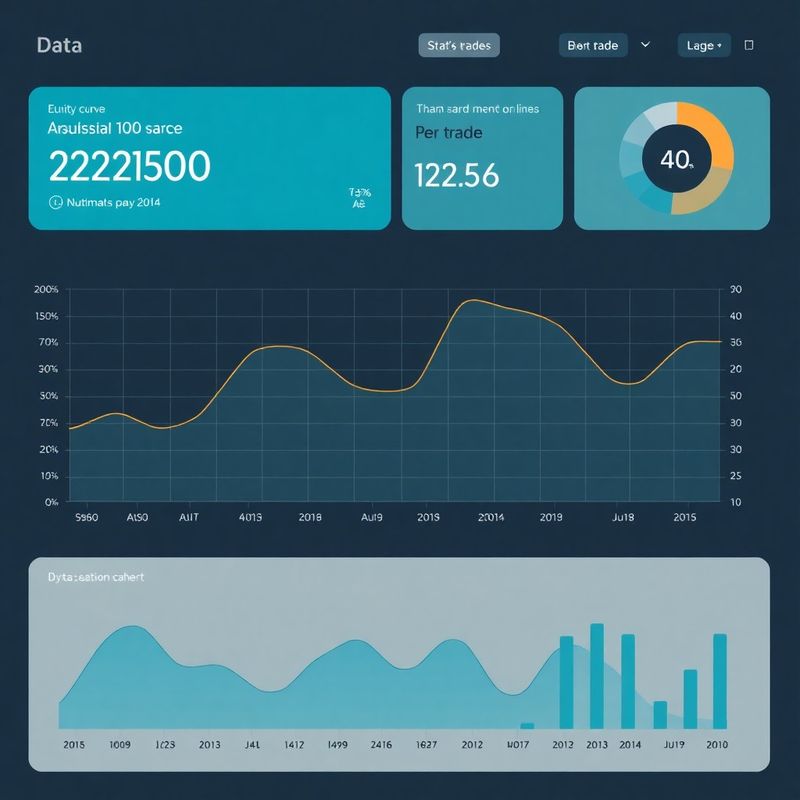
Each backtest delivers: a per-trade log with entry price, exit price, holding period, and P&L in both percentage and RON-equivalent terms; a drawdown curve with maximum drawdown marked; win rate segmented by session (Asian, London, New York); Sharpe and Sortino ratios computed on daily returns; and a summary of the worst consecutive losing sequence. We do not apply hindsight-optimised parameters — the same rule set you define in the strategy editor runs in the backtest engine with no silent modifications. Slippage and commission estimates are configurable and default to conservative values for the selected asset class.
Transparency is not just a live-trading feature — it applies equally to historical simulation.
Tests run on 1-second OHLCV aggregations, not daily candle approximations. Bar-by-bar evaluation matches exactly how the live engine processes incoming data, so the transition from backtest to live is consistent.
We never run an optimisation pass behind the scenes to make your results look better. What you defined is what was tested — and the report tells you so explicitly in its header.
Every single trade the backtest executed is available as a CSV download. You can import it into Excel or a Python notebook to apply your own analysis without depending on our interface.
I ran the same strategy on two platforms. The other platform showed a 60% win rate; Kingsley's report came back at 51%. I trusted the lower number because the per-trade log let me verify every entry myself. The honest result saved me from over-sizing my position.
Radu F., independent trader, Timișoara
No backtest perfectly predicts live performance. Liquidity conditions, regulatory changes, and market structure shifts mean that a strategy that performed well historically may not perform the same way in the future. We say this plainly in every report we deliver, and we include a section on the specific assumptions that may not hold in the current market environment for your asset class. Backtesting is a diagnostic tool, not a performance guarantee — and we design our reports to make that distinction clear.
Get in touch and we'll walk you through the data requirements and configuration options for your strategy.
Contact us